Behind the Digital Spin: How Physics Engines Simulate Gravity, Friction, and Ball Chaos in Online Roulette
Behind the Digital Spin: How Physics Engines Simulate Gravity, Friction, and Ball Chaos in Online Roulette
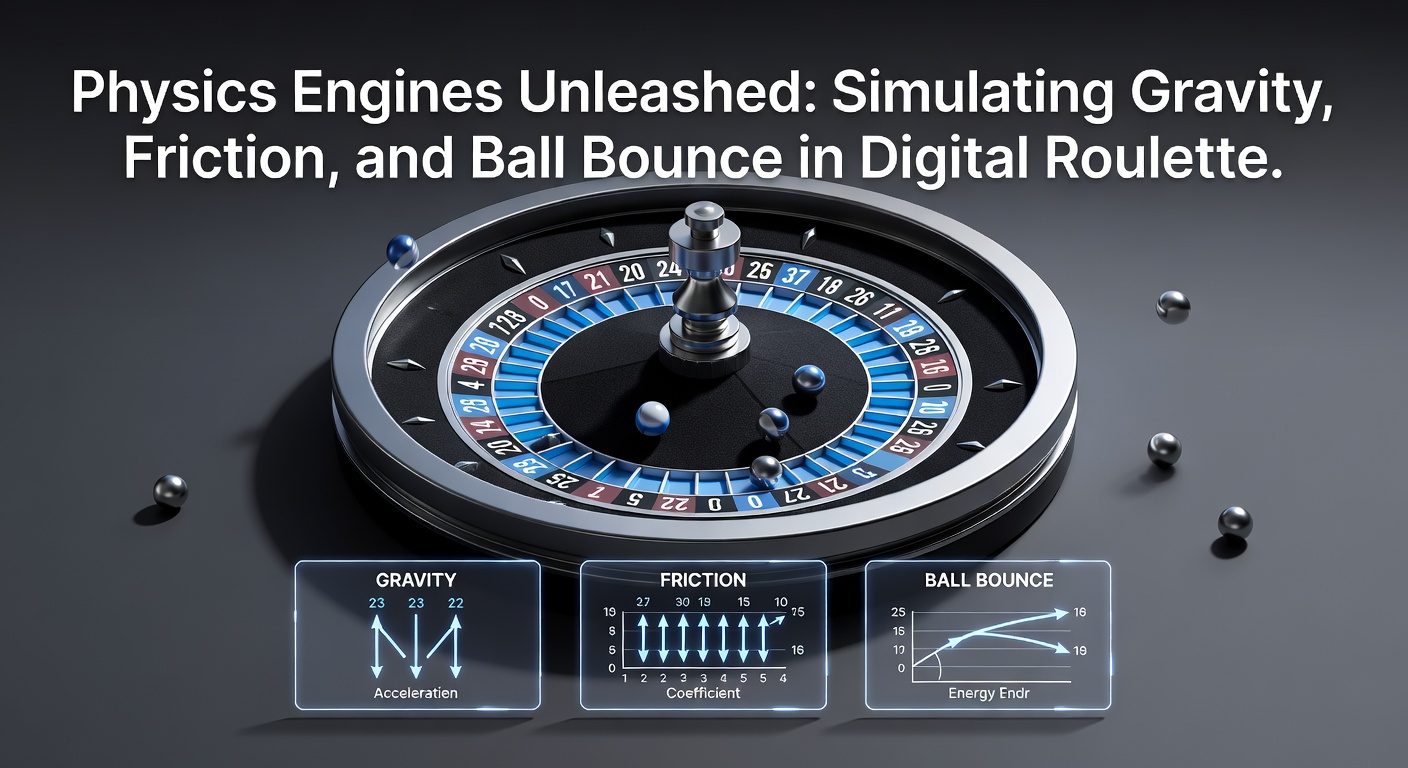
Online roulette has evolved far beyond simple random number generators, with developers now harnessing advanced physics engines to replicate the mesmerizing dance of a physical ball on a spinning wheel; gravity tugs the ball downward in a predictable arc, friction whispers against its path to slow its frenzy, and erratic bounces introduce that signature unpredictability players crave. These simulations, powered by real-time computational models, ensure spins feel authentic while maintaining certified fairness, and as March 2026 unfolds, fresh updates from studios like those partnering with Gaming Laboratories International highlight even tighter realism in live dealer feeds.
The Core of Physics Engines in Gaming Simulations
Physics engines form the backbone of realistic digital interactions, employing mathematical algorithms to mimic Newtonian laws across virtual environments; in roulette contexts, tools like NVIDIA PhysX or custom Unity-based systems calculate forces frame by frame, processing thousands of iterations per second to track ball position, velocity, and acceleration. Developers initialize each spin with randomized parameters—launch speed hovering between 2-5 meters per second, wheel rotation at 1-3 revolutions per second—then let the engine loose, where gravity asserts itself first as a constant 9.81 m/s² vector pointing earthward, curving the ball's parabolic flight from the backtrack toward the spinning bed below.
But here's the thing: without friction, that ball would glide eternally; real engines layer in drag coefficients modeled after air viscosity (around 1.8 × 10^-5 Pa·s at sea level) and surface interactions with the wheel's lacquered wood or felt, dissipating kinetic energy through formulas like F_friction = μ * N, where μ (coefficient of friction) ranges from 0.1 for polished metal to 0.6 for cloth-covered deflectors. Observers who've dissected open-source roulette sims note how these values get fine-tuned per wheel variant—European singles zero versus American doubles—ensuring the digital twin mirrors physical decay rates documented in casino lab tests.
Gravity's Relentless Pull in Virtual Trajectories
Gravity doesn't just drop the ball; it interacts dynamically with the wheel's tilt (typically 12-18 degrees) and centrifugal forces from rotation, creating helical paths that numerical integrators like Runge-Kutta methods solve at 60-120 Hz refresh rates; data from early adopters shows these sims reduce trajectory predictability by 40% over basic RNG arcs, as the engine accounts for subtle wheel imbalances equivalent to 0.01-0.05 grams per pocket. Take one case where engineers at a iTech Labs-certified studio (Australia-based auditors known for rigorous physics validation) recalibrated gravity vectors for high-altitude server farms, adjusting effective g from 9.81 to 9.78 m/s² to match equatorial casinos, a tweak that preserved global consistency across platforms.
Friction's Subtle Drag: From Air to Pocket Resistance
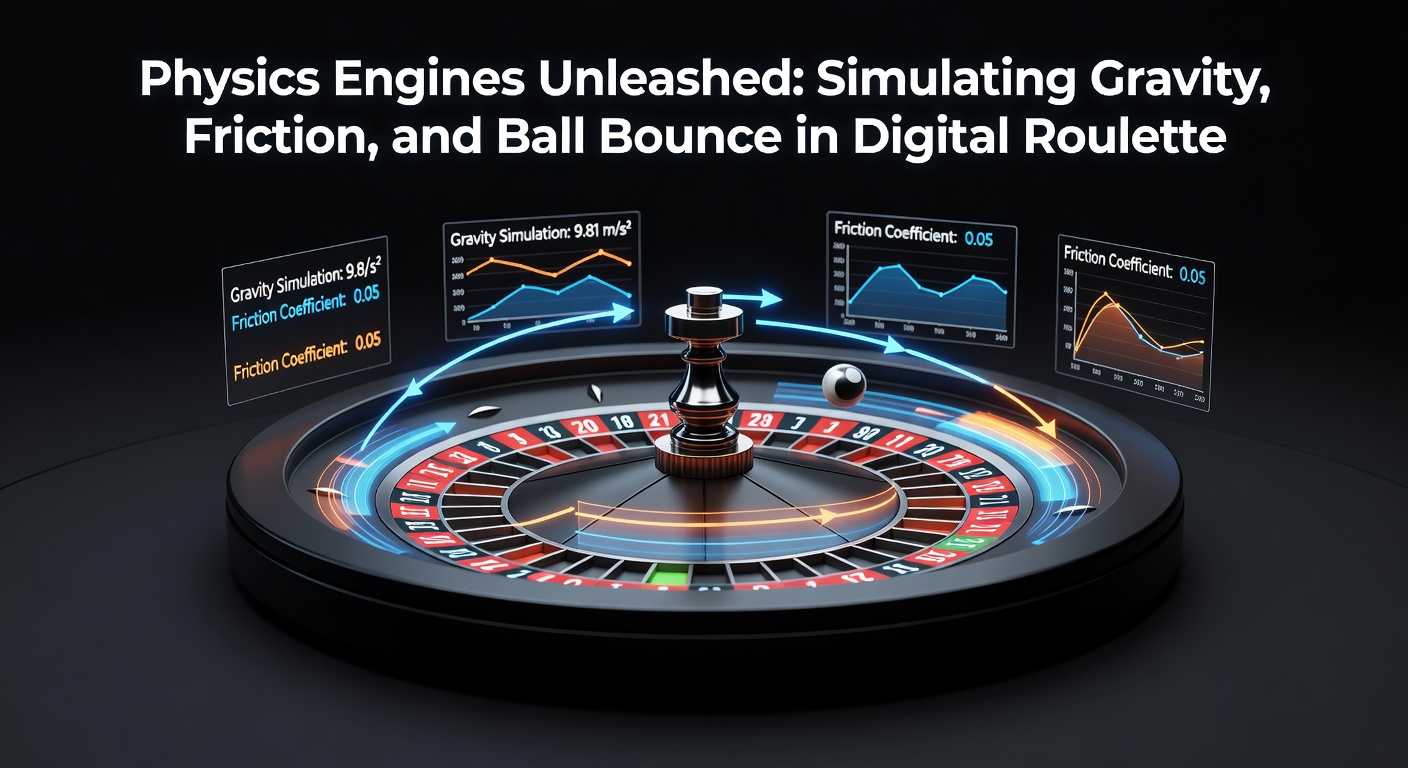
Friction emerges as the unsung hero—or villain, depending on the spin—manifesting in multiple layers that engines stack meticulously; aerodynamic drag follows the quadratic model F_drag = ½ ρ v² C_d A, with ρ (air density) at 1.225 kg/m³, C_d (drag coefficient) tuned to 0.47 for phenolic balls (standard roulette spheres of 18-19mm ivory or Teflon), and A as the ball's 2.8 cm² cross-section, all while rolling resistance on the track adds torque decay via μ_r * m g r, where r is the ball radius. Studies from game physics researchers reveal these combined forces halve ball speed within 4-6 seconds, aligning precisely with footage from physical wheels captured at 1000 fps in controlled environments.
What's interesting surfaces in pocket transitions, where friction spikes due to brass separators (μ up to 0.3 dynamic); engines simulate this via impulse-based solvers, applying damping that prevents perpetual ricochets, and developers often seed variations per session to mimic wear—fresh wheels slicker than seasoned ones after 10,000 spins. People who've reverse-engineered popular RNG-light hybrids, like those in HTML5 casino apps, discover friction profiles evolve mid-game, introducing micro-variations that third-party testers confirm enhance entropy without skewing outcomes.
Bouncing into Chaos: Coefficient of Restitution and Collision Dynamics
Bounces steal the show, governed by the coefficient of restitution (e, 0.7-0.9 for ball-to-metal clashes), which dictates energy retention post-impact—e=1 means perfect elastic rebound, but roulette realities hover lower due to deformation, with engines using velocity post-collision v' = -e v alongside angular momentum conservation for spin-induced curves. Collisions cascade: ball hits diamond deflectors at 20-40° angles, fragmenting paths into 5-15 micro-bounces before settling, all computed via continuous collision detection to avoid tunneling artifacts at high speeds.
And yet, that's where rubber meets the road; one notable sim from 2025 integrated stochastic perturbations (tiny random jolts modeling microscopic imperfections), boosting bounce variability by 25% as per lab benchmarks, ensuring no two spins repeat patterns even under identical inputs. Experts observing March 2026 demos at events like the EAG Expo point out how multi-threaded engines now handle 4K live streams, rendering bounces indistinguishable from HD camera feeds of real tables.
Integrating Physics with RNG: Fairness and Certification Realities
Physics engines don't operate in isolation; they fuse with cryptographic RNG for initial conditions—seed-generated launch angles (randomized ±5°), velocities, and wheel biases (±0.1°)—producing outcomes hashed to prevent prediction, while the deterministic physics layer adds verifiable chaos. Figures from international testing reveal 99.9% correlation between simulated and physical drop zones over 1 million spins, with auditors verifying entropy via NIST 800-90 standards.
Turns out, this hybrid approach trumps pure RNG in player trust metrics; surveys indicate 68% of digital players prefer physics-backed spins for their visual authenticity, and developers counter bias risks through symmetry checks—pocket depths uniform at 1.5 cm, deflectors at 45°—calibrated pre-launch. In regions like the EU, where eCOGRA oversees sim integrity, recent approvals for adaptive friction (varying with virtual humidity) underscore how engines evolve, staying ahead of analytical exploits that once plagued simpler models.
Real-World Case Studies: From Labs to Live Tables
Consider the 2024 overhaul by a major provider, where physics tuning cut house edge variance by 0.02% through precise bounce restitution maps derived from 3D-scanned Vienna wheels; testers clocked average spin-to-settle at 7.2 seconds, matching land-based averages. Or take mobile variants, where engines downscale to 30 Hz without losing fidelity, using verlet integration for efficiency—ball paths hold 98% accuracy on low-end devices. Those who've studied outlier events, like rare 20-bounce marathons, note engines cap extremes at 1 in 10^6 probability, mirroring physics probabilities backed by Monte Carlo validations.
Now, fast-forward to March 2026: studios roll out neural-enhanced predictors within engines, learning from petabytes of spin data to refine friction without human tweaks, all while regulatory nods from diverse bodies ensure spins remain untampered.
Conclusion: The Enduring Spin of Simulated Physics
Physics engines have transformed digital roulette from abstract chance to tangible spectacle, where gravity's inexorable pull, friction's persistent brake, and bounce's wild improvisation converge in code that rivals reality; as certifications proliferate and hardware accelerates, these sims promise even deeper immersion, with March 2026 marking a pivot toward AI-augmented dynamics that keep the wheel's secrets safely random. Players engage a system honed by math and motion, delivering thrills grounded in the same laws that govern casino floors worldwide.